Coffee roasting is the process of heating whole coffee beans, which are originally green in their raw state.
A guide to the different types of coffee roasts
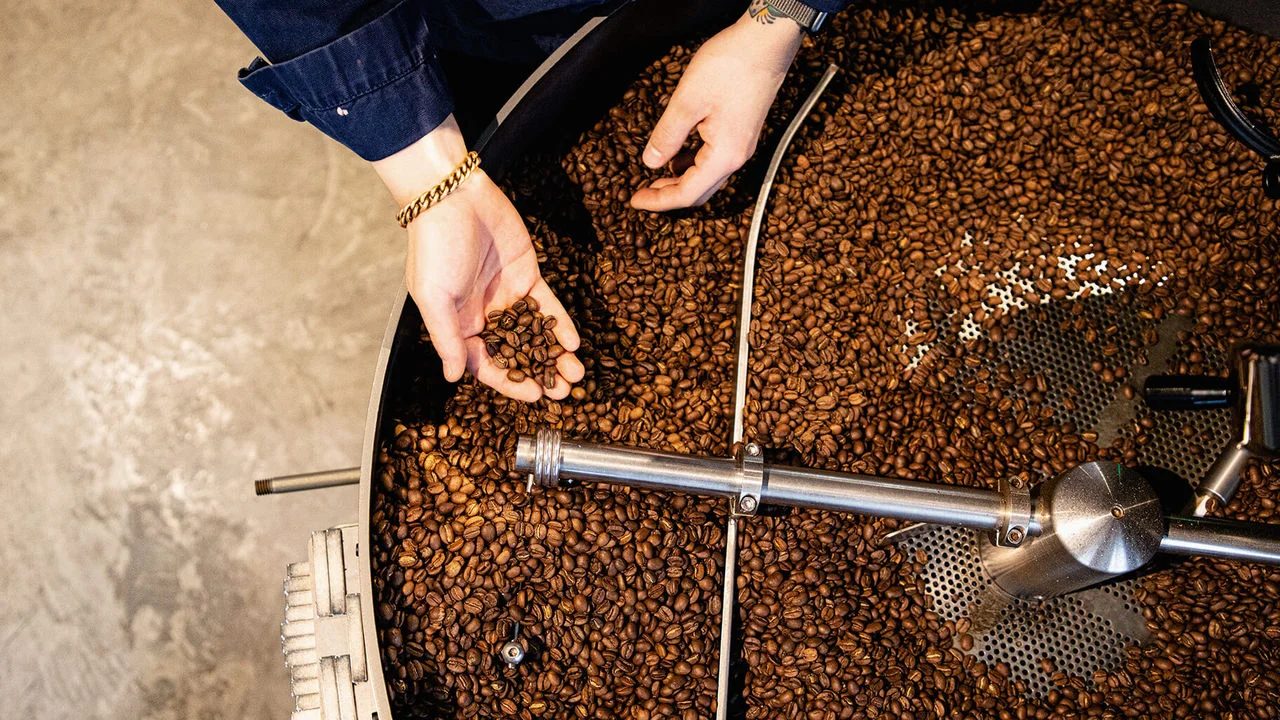
This causes a chemical reaction to draw out flavour and aroma. Roast level (ranging from light to dark or very dark) tells you how long the beans were roasted or what heat level they were exposed to.
Beyond affecting the taste and aroma, different roasts are better suited for different coffee brewing methods. Learn why roast level matters for coffee, and explore the four main types of coffee roasts below.
Why roast level matters
Roasting coffee beans transforms the chemical composition of raw beans. The process impacts the taste, body, and acidity of brewed coffee and even affects the caffeine content.,
Coffee drinkers often have a preferred roast level on account of the flavour profile. Beyond that, different roast levels can be better suited for certain brewing methods because the roasting process can change the coffee's solubility in water.
4 Types of coffee roasts
The four primary types of coffee roasts are light, medium, medium-dark, and dark.
1. Light roast
Light-roast coffee beans have been heated for a shorter time, typically at a lower temperature than darker roasts (around 195 to 210 °C).
● Colour – Lighter roasts are paler in colour than dark roasts, usually light or medium brown, sometimes with a golden hue.
● Flavour profile – This coffee roast type has a bright acidity and subtle floral or tea-like notes. Lighter roasts can also have a slightly fruity or sweet flavour profile with minimal bitterness.
● Acidity – Light-roast coffee tends to have a higher acidity than darker roasts. Coffee beans are naturally acidic, and a longer roasting time neutralises the acids.
vBody – This coffee roast has a lighter body, meaning it has a smoother mouthfeel with fewer residual oils after brewing.
● Ideal brew methods – Pour-over systems and automatic drip coffee makers are ideal for light-roast coffee, as they preserve the smooth finish and highlight the vibrant flavour. It can also work well with espresso.
2. Medium roast
Medium-roast coffee beans are roasted a bit longer at a slightly higher temperature than light roast coffee beans, usually between 210 and 220 °C. At this roast level, the beans are heated until they begin to crack from the release of hot steam building up inside (sometimes called "first crack").
● Colour – Coffee beans roasted to a medium level will be a medium brown colour. They'll also be dry, without any oil on the surface.
● Flavour profile – Medium-roast coffee tends to have a balanced flavour profile—not too bold or acidic—with an even aroma and a smooth finish.
● Acidity – This roast level is more acidic than darker beans but not quite as bright as light-roast coffee.
● Body – Right in the middle, medium-roast coffee has a balanced body that's not too heavy but has a fuller mouthfeel than lighter roasts.
● Ideal brew methods – Medium roasts are highly versatile. They're a go-to for standard coffee shop orders and work well with many brewing methods, including automatic drip, pour-over, espresso, and cafetière (French press) coffee.
3. Medium-dark roast
Coffee beans can be heated longer at a slightly higher temperature (220 to 230 °C) to achieve a medium-dark roast. This type of coffee is roasted to what's called "second crack," where the cracking sound is sharper, meaning more steam and oils are released from the beans.
● Colour – The coffee beans are dark brown in colour with a shiny appearance due to oil on the surface.
● Flavour profile – Medium-dark coffee has a rich flavour profile, often with hints of chocolate and caramel or a nutty, toasted aroma.
● Acidity – The longer roasting time and higher temperature break down the natural acidity of the coffee beans, offering a balanced yet powerful taste.
● Body – When you brew coffee from medium-dark beans, you'll have a heavier body than with lighter roasts, with a fuller, more intense mouthfeel.
● Ideal brew methods – Pour-over, cafetière, cold brew, and AeroPress brewing are best for medium-dark roasts. They allow for more control over the extraction process, helping you avoid too-strong coffee.
4. Dark roast
Dark-roast coffee beans have been roasted to the second crack or just past it. They're heated for longer or at a higher temperature than medium-roast coffee (typically 230 to 235 °C.
● Colour – Dark-roast coffee beans are very dark brown in colour, appearing almost black, and have a glossy surface due to the oils that escaped during the roasting process.
● Flavour profile – This coffee roast has a bold flavour profile and robust aroma. It's sometimes described as smoky, nutty, earthy, or even spicy. Dark roasts can be reminiscent of caramel since higher temperature and longer roasting time caramelise the natural sugars in coffee beans.
● Acidity – The longer roasting time and higher temperature neutralise the acidity of coffee beans, resulting in a smoother finish.
● Body – Dark-roast beans create a full-bodied cup of coffee with a more syrupy texture that feels more substantial in the mouth.
● Ideal brew methods – French press, pour-over, and cold brew are ideal for dark-roast coffee, as the coarser grind sizes help keep the coffee from over-extracting and becoming too strong. Dark roasts are also good for espresso because the beans are soluble yet able to withstand high pressure.
Choosing the right coffee roast for you
You can usually tell the roast level of coffee beans by looking at the colour and sheen. Golden-brown shades are lightly roasted, and the longer the beans roast at higher temperatures, the darker the colour will be. Medium-dark and dark roasts will also be shiny due to the oils that emerge during roasting. But a bag of coffee beans will typically note the roast level on the label.
Different brewing methods can affect caffeine content, but longer roasting times (that result in darker roasts) can also reduce the caffeine in coffee.
The best way to work out which roast level is right for you is to taste coffee brewed from light, medium, medium-dark, and dark-roasted coffee beans. You can do this at a café, or purchase freshly roasted beans from a local roaster or coffee shop and brew coffee at home.
Unlock the flavour with Sage
Sage has all the essentials for at-home brewing. We offer high-quality burr coffee grinders to get the precise coffee grind size for your preferred brewing method, allowing you to grind fresh beans every day.
You can also find premium espresso machines, drip coffee makers, and premium coffee accessories. Shop the collections today.
Sources:
1. Journal of Applied Science and Agriculture. A Review of Quality Coffee Roasting Degree Evaluation. https://www.researchgate.net/publication/280627747_A_Review_of_Quality_Coffee_Roasting_Degree_Evaluation
2. Scientific Reports. The effect of roast profiles on the dynamics of titratable acidity during coffee roasting. https://www.nature.com/articles/s41598-024-57256-y
3. Perfect Daily Grind. Adjusting a Brewing Recipe to Your Coffee Roast Level. https://perfectdailygrind.com/2019/10/how-to-adjust-your-brewing-recipe-for-coffee-roast-level/
4. Roast Magazine. Sweetness in Coffee: How Do We Define, Analyze and Discuss It?. https://www.roastmagazine.com/stories/sweetness-in-coffee
5. Perfect Daily Grind. Umami flavours in coffee: What should you expect?. https://perfectdailygrind.com/2022/07/umami-flavours-in-coffee/
6. Metabolites. Medium Roasting and Brewing Methods Differentially Modulate Global Metabolites, Lipids, Biogenic Amines, Minerals, and Antioxidant Capacity of Hawai'i-Grown Coffee (Coffea arabica). https://pmc.ncbi.nlm.nih.gov/articles/PMC10051321/
7. Applied Sciences. Quantitative Analysis of Caffeine in Roasted Coffee: A Comparison of Brewing Methods. https://www.mdpi.com/2076-3417/14/23/11395
8. Roast Magazine. Beyond Elevation: How Bean Density Informs Roasting and Flavor. https://www.roastmagazine.com/stories/beyond-elevation
9. Daily Coffee News. What is a 'Light Roast?' Researchers Outline Vision for a Universal Standard. https://dailycoffeenews.com/2025/07/29/what-is-a-light-roast-researchers-outline-vision-for-a-universal-standard/
10. Journal of Food Science and Technology. The influence of roasting and additional processing on the content of bioactive components in special purpose coffees. https://pmc.ncbi.nlm.nih.gov/articles/PMC4554650/
11. Saudi Journal of Biological Sciences. A study of chemical Composition, Antioxidants, and volatile compounds in roasted Arabic coffee. https://pmc.ncbi.nlm.nih.gov/articles/PMC8958316/
12. University of California, Davis, College of Engineering. New Research Shows Roasted Coffee Beans Follow a 'Universal Color Curve'. https://engineering.ucdavis.edu/news/new-research-shows-roasted-coffee-beans-follow-universal-color-curve
13. IOP Conference Series: Earth and Environmental Science. The changes in chemical properties of coffee during roasting: A review. https://www.researchgate.net/publication/358340174_The_changes_in_chemical_properties_of_coffee_during_roasting_A_review
14. Beverages. Roasting Conditions and Coffee Flavor: A Multi-Study Empirical Investigation. https://www.mdpi.com/2306-5710/6/2/29
15. Perfect Daily Grind. Understanding Body in Coffee and How to Roast for It. https://perfectdailygrind.com/2020/06/understanding-body-in-coffee-and-how-to-roast-for-it/
16. Colloids and Surfaces A: Physicochemical and Engineering Aspects. Interfacial properties of coffee oils. https://www.sciencedirect.com/science/article/abs/pii/S0927775710000968
17. Perfect Daily Grind. What Is First Crack and How Do You Recognise It?. https://perfectdailygrind.com/2017/05/what-is-first-crack-and-how-do-you-recognise-it/