Sous Vide FAQ: Time, Temperature & Probing
Where can I find times and temperatures?
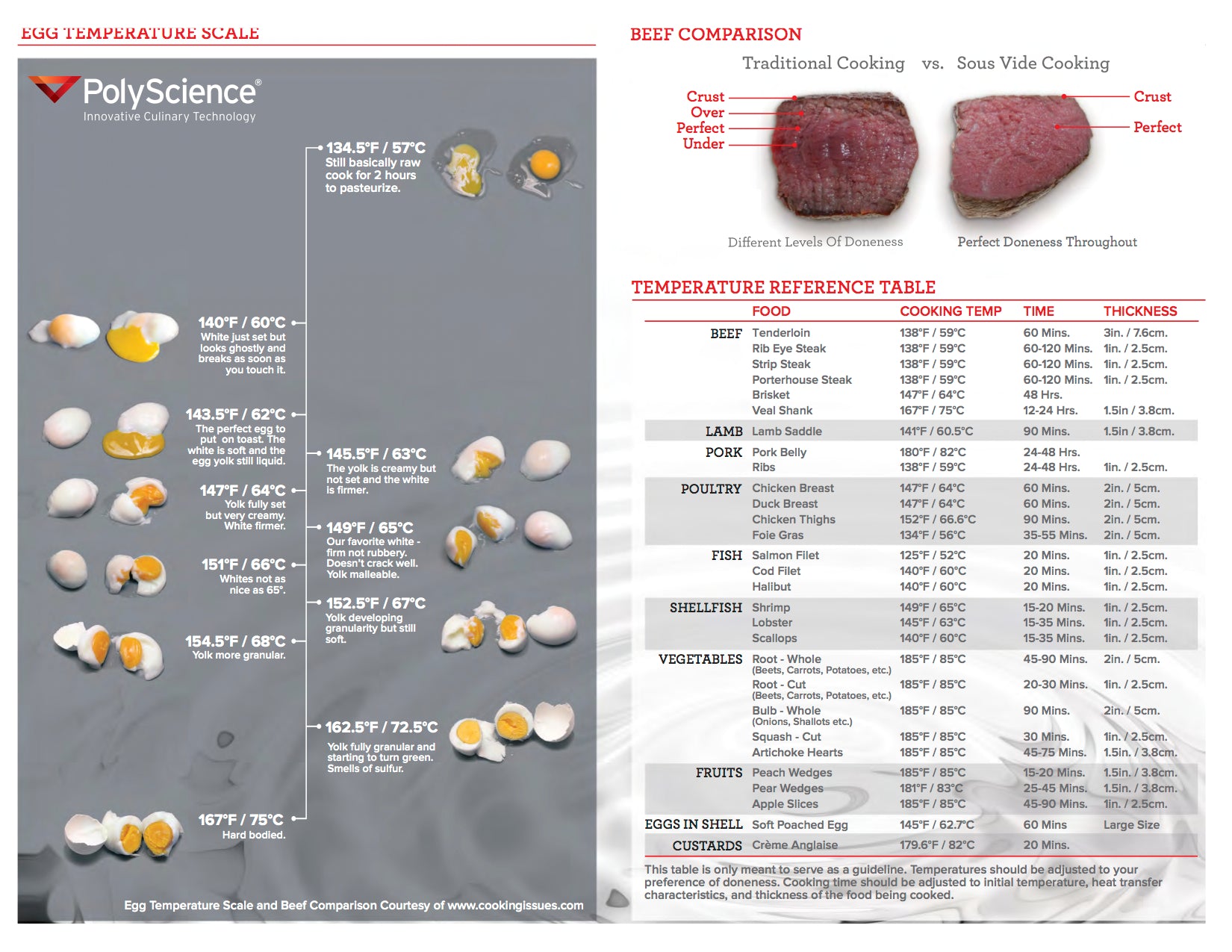
PolyScience provides a Sous Vide cookbook with the Sous Vide Professional™ that lists several recipes and a table with time/temperature guidelines for the most commonly Sous Vide cooked foods. Find a downloadable version here.
How is the time required to cook food Sous Vide determined?
With Sous Vide, there is a much greater window of time for perfect doneness. Time is much less critical since food is not overexposed to heat and, thus, cannot overcook in a traditional sense.
Cooking times depend on thickness and tenderness of the food. It can range from as little as 20 to 30 minutes (lean fish, foie gras, scrambled eggs) to as long as 72 hours (spare ribs, tough meats).
Thickness: How long it takes a given portion of food to come to temperature depends on the thickness of the portion, not the total weight. Cooking time increases exponential to thickness. A 4-inch-thick steak needs at least 3 times the cooking time of a 2-inch-thick steak.
Tenderness: Tender or delicate foods (fish, shellfish, foie gras, beef or pork tenderloin, lamb chops) need only to be brought to the desired serving temperature to be delicious and ready to eat. Extended cooking times can result in their becoming overly tender to the point of mushiness. Portioned chicken breasts and tender steaks typically take a minimum of one or two hours, depending on thickness.
Tougher foods (roasts, grass-fed cuts, game, spare ribs) will be brought to temperature based on the thickness of the portion, but then benefit from slow, low cooking for hours to tenderise them. Skirt steaks and top round roasts typically take a minimum of six hours and a maximum of twelve hours. Ribs and briskets cook for twenty-four to forty-eight hours.
Tables for time and temperature are available in the reference section of this website.
Can you cook steaks to different levels of doneness at the same time?
You would not cook them at the same time, but there are simple tricks to prepare different levels of doneness.
Method 1: Cook all steaks in the water bath to medium-rare, then, when finishing the steaks in the frying pan or on the grill, simply leave the medium steak on for a bit longer.
Method 2: Cook the two steaks sequentially – the medium steak in a 140°F/60°C a day or one hour beforehand, then lower the temperature to 138°F/59°C and add the medium-rare steak for another hour. Both cook to perfection. The medium steak will not overcook since it is only being held until ready to serve. After the medium-rare steak is cooked to perfection, sear them quickly for flavour and appearance in a hot frying pan or on a grill.
Is there a way to measure internal temperature of meat as it cooks?
Yes. It can be done if you don’t have the PolyScience recipes handy or want to develop your own recipes. The best way is to cut the bag open on the top, measure the temperature and reseal the bag if necessary. Other ways are to apply foam tape on the bag, poke a temperature needle through the bag and measure that way. However, this method cannot be considered as food safe, because it is breaking the seal and very likely leaks water into the bag. We recommend this method only for recipe development but not for food that’s served for consumption.
At what temperature do you cook food Sous Vide?
Using the Sous Vide method, a food is cooked precisely and gently at its desired serving temperature. Sous Vide cooking temperatures are generally in the range of 115-190ºF, and always below boiling.
The key to successful Sous Vide cooking is maintaining a consistent water temperature throughout the cooking period. A difference of as little as one degree can change appearance, flavour and texture of some foods.
This level of control allows you to repeat over and over the exact same results of your steak, chicken, scallops, or eggs.
Quick reference for cooking temperatures of common foods:
Meat –120°F/49°C (rare); 134°F/56°C (medium-rare); 140°F/60°C (medium); 150°F/65°C (medium-well)
Poultry – white meat – 140°F/60°C to 146°F/63°C up to 160°F/71°C as desired
Poultry – dark meat – 176°F/80°C
Fish – 116°F/47°C (rare); 126°F/52°C (medium-rare); 140°F/60°C (medium)
Shellfish – 135°F/56°C to 140°F/60°C
Vegetables –185°F/85°C
Eggs – 147°F/64°C (soft boiled) to 167°F/75°C (hard boiled)
Custard – 170°F/76.5°C
Can I cook slow cooker recipes with the Sous Vide Professional™?
Yes, every slow cooker recipe will work and turn out even more delicious and cooked perfectly according to your set temperature.
For well-done foods, simply cook all ingredients together at 185°F/85°C.
For medium-rare or medium foods, lightly sauté or steam vegetables in the frying pan and then add them to the meat and spices and cook in vessel or food-safe pouch.
How do I set up the Sous Vide Professional™ as a slow cooker?
To cook the recipe in a Sous Vide Professional™, you can:
1. Use food-grade zip-closure pouches: Remove air and close zip
2. Vacuum seal food
3. Fill food into stainless steel or ceramic cooking vessel that will fit into the water bath, controlled by the Sous Vide Professional™.