Food Safety with Sous Vide Cooking
A: Sous Vide Cooking Process
As with any food process, sous vide requires specified food handling practices to prevent, eliminate, or reduce the food’s biological, chemical, and physical hazards to a safe level.
Three important aspects require additional attention:
• Vacuum-packaged food creates an anaerobic (oxygen-free) or reduced-oxygen environment. With improper food handling, some of the most dangerous bacteria can grow, such as salmonella and botulism. Safe food handling and hygiene standards should always be maintained.
• Food cooked at low temperatures for extended periods of time can cause bacteria to multiply rapidly. The longer food is in the “danger zone” – temperatures between 40°F and 140°F (4.4°C to 60°C) – the faster bacteria can multiply and the more dangerous they can become.
• When food in pouch has finished the required cooking time, it has to be removed and served immediately, or rapidly chilled. Cooling must be less than 6 hours from 130 to 41ºF.
Carefully read and incorporate these detailed guidelines into your cooking method to assure safety in each step.
Prerequisites to food preparation.
• Make sure that the refrigerator is 41ºF or colder. The colder the refrigerator, the slower the spoilage of ingredients.
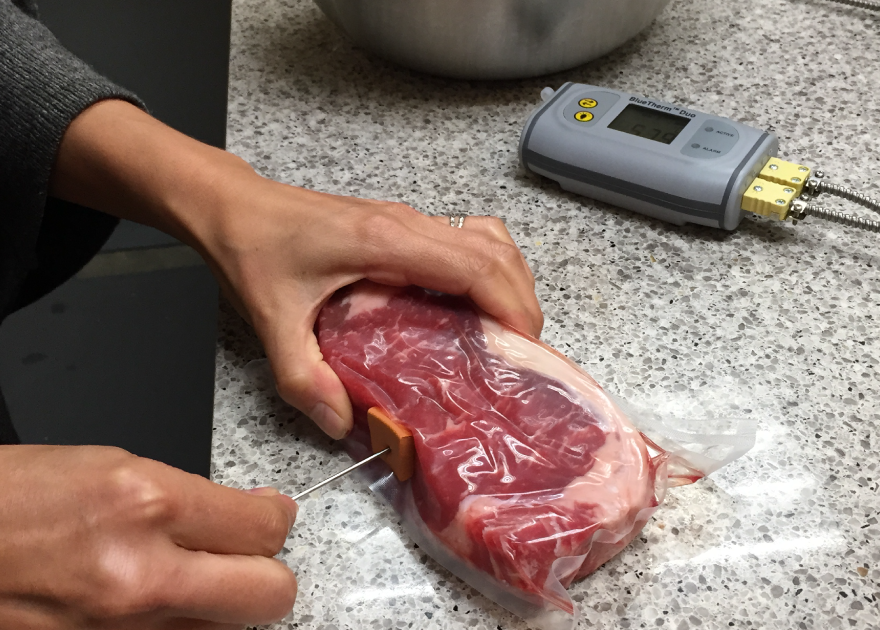
• Get an accurate digital food thermometer to check the temperature of the raw and cooked food to ensure that it reached a desired end point.
• Get the plastic pouches that the food will be packaged in. Make sure that they are not contaminated.
• Use detergent, warm water, wash , and rinse the food contact surfaces. Disinfect the surfaces with a solution of 1-teaspoon chlorine bleach per gallon of water to prevent cross-contamination.
• Be sure to separate the raw ingredient preparation area from the finished product area, or wash, rinse, and disinfect a surface when changing from raw preparation to finished food.
Sous vide processing.
• The basic steps of the sous vide process are shown in the following flow chart. Details to each step are provided below the flow chart.
Prepare the work area. Put away unnecessary objects. Clean and disinfect food contact surfaces, and store chemicals so that they cannot contaminate the food.
|
↓
|
Get fresh ingredients. Sous vide cannot make spoiled ingredients taste good. It amplifies the flavours and should only be applied to the freshest ingredients.
|
↓
|
Trim, cut, and prepare ingredients. Remember, the thicker the protein ingredient, the longer it takes to come to its cooking temperature. Less than 2-inch thickness is a practical maximum thickness. Weigh additives carefully. Safe cook times can be calculated in PolyScience iPhone/iPad app “Sous Vide Toolbox”
|
↓
|
Package / vacuum seal. The purpose of the vacuum is to pull the plastic pouch film tight against the food for good heat transfer. Check the seal.
|
↓
|
Cook / pasteurise. Reduce vegetative pathogens such as Salmonella 5 log (100,000 to 1). Cooking / pasteurisation begins about 130ºF.
|
↓
|
Hold at cooking temperature until desired degree of doneness is achieved.
|
↓
|
Cool fast enough to prevent the outgrowth of spores.
|
↓
|
Cold hold meat, poultry, and vegetables at 41ºF to prevent the outgrowth of spores and slow growth of spoilage organisms.
|
↓
|
Warm (reheating) and serve.
|
Set Up Sous Vide Professional and Water Bath
• Clamp Sous Vide Professional to a stockpot or any other vessel. Fill with water up to maximum level, indicated on Sous Vide Professional.
• To guarantee precise temperature control, refer to user manual for maximum water volume. For example the Sous Vide Professional CHEF Series has a maximum of seven gallons or twenty-eight litres of water. A second Sous Vide Professional may be required to maintain the level of precise temperature control with larger volumes.
• Set the Sous Vide Professional to desired temperature. Cover bath with lid or plastic wrap for efficient heat-up time and to avoid evaporation.
Get fresh ingredients; Trim, cut, and prepare ingredients.
• One must start with very fresh ingredients in order to assure that off-flavours from spoilage are minimal and are not amplified in the cooking method. Also, by focusing on freshness, it will assure lower spoilage bacteria counts at the start of refrigerated storage so that the finished product will have a longer refrigerated shelf life.
• It is safer if you use solid, not ground or punctured, pieces of meat, poultry, or fish. When it is punctured, it becomes critical that not only the surface, but the centre of the food also gets hot enough for long enough to be pasteurised.
• Since cooking is done in a plastic pouch, there is no loss of flavour volatiles in sous vide cooking.
Package / vacuum seal.
• The vacuum is not for flavour. It is to have a good heat transfer between the water bath and the surface of the food.
• Assure that food-grade quality plastic pouches that have not become contaminated in storage are used; 2 to 3-ml plastic is adequate. If zip-lock bags are used, assure that they are heat-safe to the temperatures you will be cooking at.
• Make sure food is refrigerated at 38°F (3.3°C) or below until ready to seal.
• To ensure precise and even cooking, arrange pieces of food in the plastic bag in a single layer.
• Check vacuum bag for proper seal before cooking.
• As bags are sealed, check to be sure that there was no crease in the plastic and that the seal is uniform with an even fusing from one side to the other.
• After sealing, immediately cook or refrigerate food at 38°F (3.3°C) or below until ready to cook (see storing tips on the following page).
Cook / pasteurise.
• Insert vacuum-sealed bag only when bath has reached correct temperature.
• Follow time and temperatures guidelines and consider increasing cooking time if food has a larger diameter than specified in the recipe.
• Cooking time increases by a factor of almost 4 times per extra inch. If you only double the time per inch, it will be unsafe!
• In case you are not able to remove all the air due to limitations of your vacuum sealer, you can weigh down the pouch with a heavy porcelain plate to ensure it is fully submerged. This is important to ensure safe cooking results.
• If you cook more than one vacuum bag, make sure they are not too close to each other.
• Make sure to hold the pouch under the water so that it is fully cooked. Food safety times and temperatures are based on centre temperatures of the food.
• Check temperature and sealed vacuum bag frequently during cooking process. A bag that suddenly begins to float, inflate, or leak is a sign of food-safety issues. Discard food and clean tank and Sous Vide Professional.
• If, during cooking in the water bath, the bag balloons and floats to the surface, a seal has failed, or the temperature is too hot and steam has formed in the package, or there is a pinhole. The package must be thrown away, because you do not know if there was adequate heat transfer and pasteurisation was effective.
• Always measure the internal temperature of foods before serving. You can re-seal a pouch and continue cooking if necessary.
• If you are making more than one pouch, a very smart thing to do is to sample the first pouch removed from cooking. Take your digital thermometer and verify the centre temperature of the food. Also sample the flavour of the product. If it needs more cooking, you can reseal the pouch and continue to cook.
• If you are cooking fish to a temperature of less than 130ºF, there are parasite and vegetative pathogen risks. Undercooked fish should have been frozen at –4ºF for 7 days to assure the destruction of the parasite, and the customer should be informed that undercooked food has some illness risk.
There will be two primary biological hazards in the meat, poultry, fish, vegetables or fruit that are cooked sous vide.
The first hazard is vegetative pathogens, and the regulatory target is Salmonella. The goal is to cook the food in the pouch to a time and temperature to reduce Salmonella 100,000-to-1. This will reduce the Salmonella from a maximum of 1,000 per gram in the raw food to 1 per 100 grams in the finished food. Salmonella is used as the target organism, because it has been, and continues to be, a major cause of illness and kills an estimated 500 people each year.
The government-specified times and temperatures for this pasteurisation are:
Centre temperature
|
Hold Time
|
130ºF
|
112 minutes
|
140ºF
|
11 minutes
|
150ºF
|
1 minute
|
155ºF
|
5 seconds
|
158ºF
|
instant (less than 1 second)
|
The second biological hazard common to the ingredients from the water and land farms are the spores, Clostridium botulinum [proteolytic (meat, poultry) and non-proteolytic (fish, seafood)], Bacillus cereus (cereal products), and Clostridium perfringens (meat, poultry, lentils).
When the food is pasteurised, Salmonella is reduced to an Appropriate Level of Protection (ALOP), but pasteurisation temperatures have no kill effect on the spores. Pasteurisation just activates the spore.
IMPORTANT:
It’s a rule of thumb that if you cook below 130°F (54.4°C) there is an increased risk for vegetative pathogen and parasite development. However, food safety depends on a combination of temperature, time, pH level and the freshness of the ingredients. Extended cooking time pasteurises food and reduces potential salmonella to an appropriate level.
Hold.
• After the food is pasteurised, if the food is hotter than 130ºF, the spores cannot germinate and multiply, regardless of time.
• One can hold/tenderise for 24 to 48 hours safely. This is also a major feature of sous vide.
• If the cooking temperature is 130 to 150ºF, there is an additional benefit. The enzymes are very active, and the meat becomes very tender.
Chill.
• At this point, the spore is activated (pasteurisation has no kill effect on spores, it activates spores); therefore cooling becomes a critical control procedure.
• The target spore for cooling is Clostridium perfringens. It must be controlled so that there is less than a 1 to 10 increase in population during cooling.
• To assure safety, cooling must be less than 6 hours from 130 to 41ºF. This is easily done for most sous vide products if they are less than 2 inches thick in a proper ice bath.
• The recommendation for a proper ice bath is: ratio of 1-lb ice to 1-lb product, topped off with cold tap water. Agitation will increase the effect of a rapid chill process.
• It limits roasts to about 5 pounds. After the cooling to 41ºF, C. perfringens cannot multiply, and the target spore for storage is Bacillus cereus for all food except fish. Holding at 41ºF controls B. cereus.
• For cooked fish, there is a critical limit of 37.4ºF to prevent the non-proteolytic C. botulinum on the fish from growing. If cooked fish is to be stored after cooling, it should be frozen or held in ice at less than 37.4ºF, or served within 7 days if held at 41ºF.
Cold hold.
• Before storing, label vacuum-sealed bags with expiration date and contents.
• For practical purposes, if the preceding instructions are followed there is probably no significant reason to hold sous vide product for more than 7 days.
• If the recipe includes inhibitors, such as salt or acidity, food can be stored up to 45 days, as long as temperature of meat and poultry is 41ºF or colder, or fish and seafood is less than 37.4F (3.0ºC).
• Only spores or some surviving spoilage organisms can multiply, and temperature is the critical control.
Warm (reheating) and serve.
• Reheating is not for safety; it is a quality factor to meet consumer desires.
• The food is safe if the preceding instructions are followed, and the food can be eaten cold from the pouch or removed from the pouch and browned and heated to suit the consumer.
• When reheating cooked food, simply bring water bath back to desired serving temperature and apply time needed for core to reach temperature.
• Always measure the internal temperature of foods before serving. You can re-seal a pouch and continue cooking if necessary.
• If reheated in the bag, consider that spores or some surviving spoilage organisms can multiply. Temperature is the critical control.
• A major safety advantage of sous vide is that it was pasteurised in the package, so there is no chance of contamination of the product by vegetative pathogens in storage after cooling.
• Cooked foods that are frozen must thaw under refrigeration (41°F or below) and reheated upon complete thaw, prior to consumption. What did PolyScience use to determine the appropriate time and temp to get the desired log reduction?
Here are some of the most relevant sources we used in creating the app. Note that we don’t use their numbers directly, but rather we use the mathematical techniques they describe and model them dynamically for each unique cooking scenario a user enters.
• A. H. Geeraerd, C. H. Herremans, and J. F. Van Impe. Structural model requirements to describe microbial inactivation during a mild heat treatment. International Journal of Food Microbiology, 59:185–209, 2000.
• Lihan Huang. Computer simulation of heat transfer during in-package pasteurization of beef frankfurters by hot water immersion. Journal of Food Engineering, 80:839–849, 2007.
• FSIS. Time-temperature tables for cooking ready-to-eat poultry products. Notice 16-05, Food Safety and Inspection Service, 2005.
Much of the early work in the field was for fixed temperature pasteurisation, but the D_ref and T_ref approach we use is more and more common these days.
The mathematical technique we used is also presented very concisely at the end of Appendix A of Douglas Baldwin’s seminal work at http://www.douglasbaldwin.com/sous-vide.html.
B: Highly Susceptible Audience
Children, elderly and expectant mothers and those with compromised immune systems should not consume raw or undercooked foods.
Many temperatures listed on this website (www.polyscienceculinary.com) and within PolyScience Sous Vide Professional™ literature, manuals, applications and marketing include “threshold temperatures,” which are considered to be at the low end of FDA-required cooking temperatures.
Anyone in these audiences should cook all recipes listed on this website or within PolyScience Sous Vide Professional™ literature, manuals, applications and marketing 2°C/4°F higher than listed in the recipe and for 5% more time (Calculator) to ensure proper cooking temperatures and pathogenic reduction. For further information on accepted safe cooking temperatures, please visit www.FDA.gov
C: Further Resources
• FDA Food regulatory criteria for sous vide on www.fda.gov
• Comprehensive temperature guidance and pathogenic log reduction can be safely calculated with the PolyScience Sous Vide Toolbox™ application for Apple iOS.